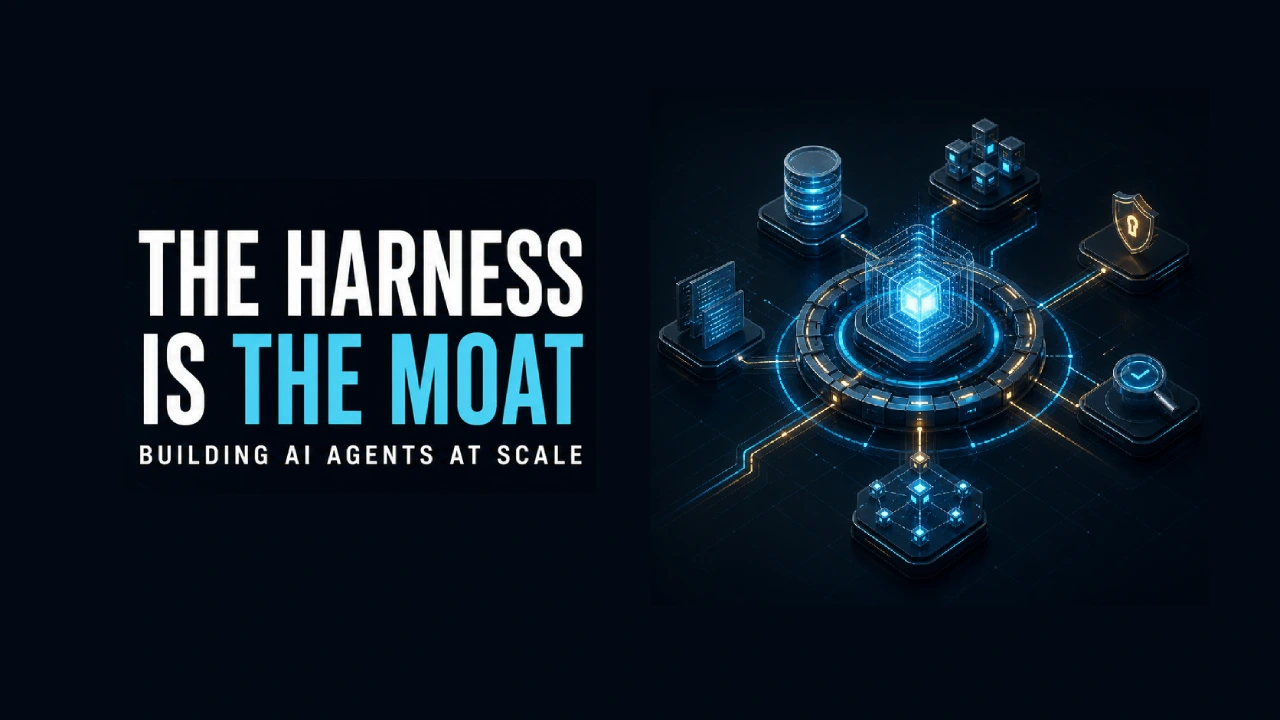
AI Agent Harness: The Real Moat for Scalable AI
 By
By An AI agent harness determines how a model receives context, accesses tools, remembers information, performs actions, delegates work, verifies results, and operates within security and cost limits. The model provides intelligence, but the harness transforms that intelligence into a dependable product.
What Is an AI Agent Harness?
An AI agent harness is the orchestration layer that connects a language model to the resources it needs to complete real work. It controls the complete execution cycle—from receiving a request to returning a verified result.
A practical harness may include:
- System instructions and agent identity
- Conversation and organizational memory
- Application-specific tools and APIs
- Secure execution environments
- Context-window management
- Multi-agent delegation
- Authentication and authorization
- Logging, monitoring, and auditing
- Token usage and cost controls
- Output validation and verification
Without these components, even an advanced model remains little more than a sophisticated text generator. With a well-designed harness, the same model can become a secure and reliable digital worker.
Why the Model Alone Is Not a Competitive Advantage
Most companies can access the same commercial AI models. They can use similar APIs, configure comparable model parameters, and generate responses with similar levels of intelligence.
This makes the model increasingly interchangeable. A product can move from one capable model to another without completely changing its business value.
However, the workflows, context strategy, tool integrations, security controls, memory architecture, and evaluation systems developed around that model are much harder to reproduce. They represent accumulated engineering knowledge and an understanding of real customer needs.
In other words, the model may be available to everyone, but the craftsmanship behind a reliable AI system is not.
The Core AI Agent Execution Loop
Most useful AI agents operate through a repeating execution loop:
- Assemble the context: The harness collects the agent’s instructions, user identity, relevant memory, conversation history, available tools, and the current request.
- Call the model: The model evaluates the information and decides whether to answer directly or use a tool.
- Execute the tool: The harness safely runs an API call, script, database query, file operation, or delegated task.
- Return the result to the model: The output is filtered, compressed, recorded, and added to the next context window.
- Repeat or finish: The cycle continues until the task is completed or a defined execution limit is reached.
This loop appears simple, but its implementation determines whether the agent is fast, affordable, secure, and trustworthy.
Five Essential Parts of a Production AI Harness
1. A Workspace for Persistent Work
Agents often need to create files, examine previous outputs, process data, and continue working across multiple steps. A controlled filesystem or workspace allows the agent to retain useful artifacts during a task.
Permanent capabilities should be stored as version-controlled tools and scripts, while temporary files should remain isolated and disposable.
2. Tools That Allow the Agent to Act
A model can explain how to perform a task, but tools allow it to complete the task. These tools might search a knowledge base, retrieve customer information, create a report, analyze a document, update a project, or communicate with another service.
Tools should follow consistent interfaces so the harness can call them without creating special logic for every integration.
3. A Secure Sandbox
Allowing an AI agent to execute code or access external systems introduces real security risks. Tool execution should therefore take place inside an isolated environment with clearly defined permissions.
The agent should only be able to access the files, network destinations, APIs, and credentials required for its assigned task. This limits the potential impact of mistakes, malicious instructions, or unexpected model behavior.
4. Carefully Managed Context
Context is more than a single prompt. A production agent may need instructions, operating procedures, tool descriptions, user information, memory, conversation history, and previous tool results.
Sending everything to the model on every turn creates unnecessary cost and may reduce response quality. A good harness selects only the information that is relevant to the current step.
5. Specialized Sub-Agents
Complex tasks can often be divided among specialized agents. A coordinator may plan the work while other agents focus on research, coding, verification, data analysis, or document creation.
Delegation can improve speed and quality, but it must be controlled with clear responsibilities, execution budgets, and verification rules.
Context Engineering Is More Important Than Prompt Engineering
Prompt engineering usually focuses on writing better instructions. Context engineering addresses a much broader question: What should the model know at this exact moment?
A well-designed context can contain:
- The agent’s role, behavior, and restrictions
- Approved operating procedures
- A lightweight catalog of available tools
- The authenticated user’s identity and permissions
- Relevant organizational or personal memory
- Recent conversation history
- Compressed results from previous tool calls
- The user’s current request
Static information can be cached and reused, while frequently changing information should be rebuilt for each turn. Large tool outputs can be stored externally, with only a summary and reference retained in the active context.
This approach keeps the agent focused while reducing latency and token consumption.
Memory Should Improve the Agent Without Removing Human Control
Long-term memory enables an AI agent to remember important preferences, organizational facts, previous decisions, and working patterns. However, automatically saving everything can introduce incorrect or sensitive information into future conversations.
A safer memory architecture separates knowledge into levels such as:
- Organization memory: Information shared across the company
- Team memory: Knowledge relevant to a particular department
- User memory: Individual preferences and working habits
Important changes to shared memory or operating procedures should require human approval. The system can learn quickly, but permanent promotion of that learning should happen carefully.
Authorization Must Be Part of the Harness
An agent should never guess who a user is or what that user is allowed to do. Identity and permissions must come from a trusted authentication system and be added to the context for every relevant request.
Administrative actions, data access, tool availability, and memory permissions should all be enforced by the application—not merely described in a prompt.
If the system cannot verify the requester’s identity, it should treat the request as unauthenticated and restrict access accordingly.
Token Economics Matter at Scale
An agent may call the model several times while completing one task. If the entire context is resent during every step, token consumption grows rapidly.
A production harness can control these costs through:
- Prompt caching: Reusing stable instructions across multiple model calls
- Output compression: Summarizing large tool responses while preserving the original data elsewhere
- Selective tool loading: Showing the model only the tools needed for the current task
- Knowledge gating: Retrieving memory only when it is relevant
- Model routing: Using lower-cost models for simple steps and more capable models for difficult reasoning
- Execution limits: Preventing uncontrolled or repetitive tool calls
These optimizations are not merely infrastructure details. They directly affect the profitability and scalability of an AI-powered SaaS product.
Reliability Comes From Verification
AI-generated output should not automatically be treated as correct. A strong harness verifies important results before presenting them to the user or executing irreversible actions.
Verification may involve schema validation, automated tests, policy checks, source confirmation, permission checks, or review by a specialized agent. High-risk actions may also require explicit human approval.
The objective is not to eliminate every possible error. It is to create a system where errors are detected early, contained safely, and made observable.
The Lasting Advantage Is Engineering Craft
Models will continue to improve, and today’s leading model may eventually be replaced by another. A well-designed harness allows a product to benefit from those improvements without rebuilding its entire architecture.
The lasting advantage comes from understanding users, designing effective workflows, choosing the right context, defining safe tools, controlling costs, and verifying outcomes. These capabilities accumulate over time and become increasingly difficult for competitors to replicate.
A great model can be accessed through an API. A great AI system must be deliberately engineered.
Final Thoughts
When building an AI application, it is tempting to spend most of the time comparing models. Model selection is important, but it is only one part of the product.
The AI agent harness determines whether the model can perform useful work consistently, securely, and economically. It turns raw intelligence into a production-ready system.
As AI models become increasingly accessible, the strongest competitive advantage will belong to teams that build the best context, tools, memory, security, verification, and execution loops around them.
The model provides the capability. The harness creates the product.
This article was inspired by the presentation “The Harness Is the Moat: Running AI Agents at Scale” by Sumith Jitta.